 Medically Reviewed by: Dr. Bo Reményi | Written by: [ROHIT KUMAR]
Am I Having A Heart Attack? A Self-Check Quiz for Women
🚨 CRITICAL MEDICAL ALERT: If you are experiencing symptoms right now and suspect you might be having a heart attack, please stop reading this page immediately and call 000 (or your local emergency number). An online quiz cannot diagnose a medical emergency. Every minute counts.
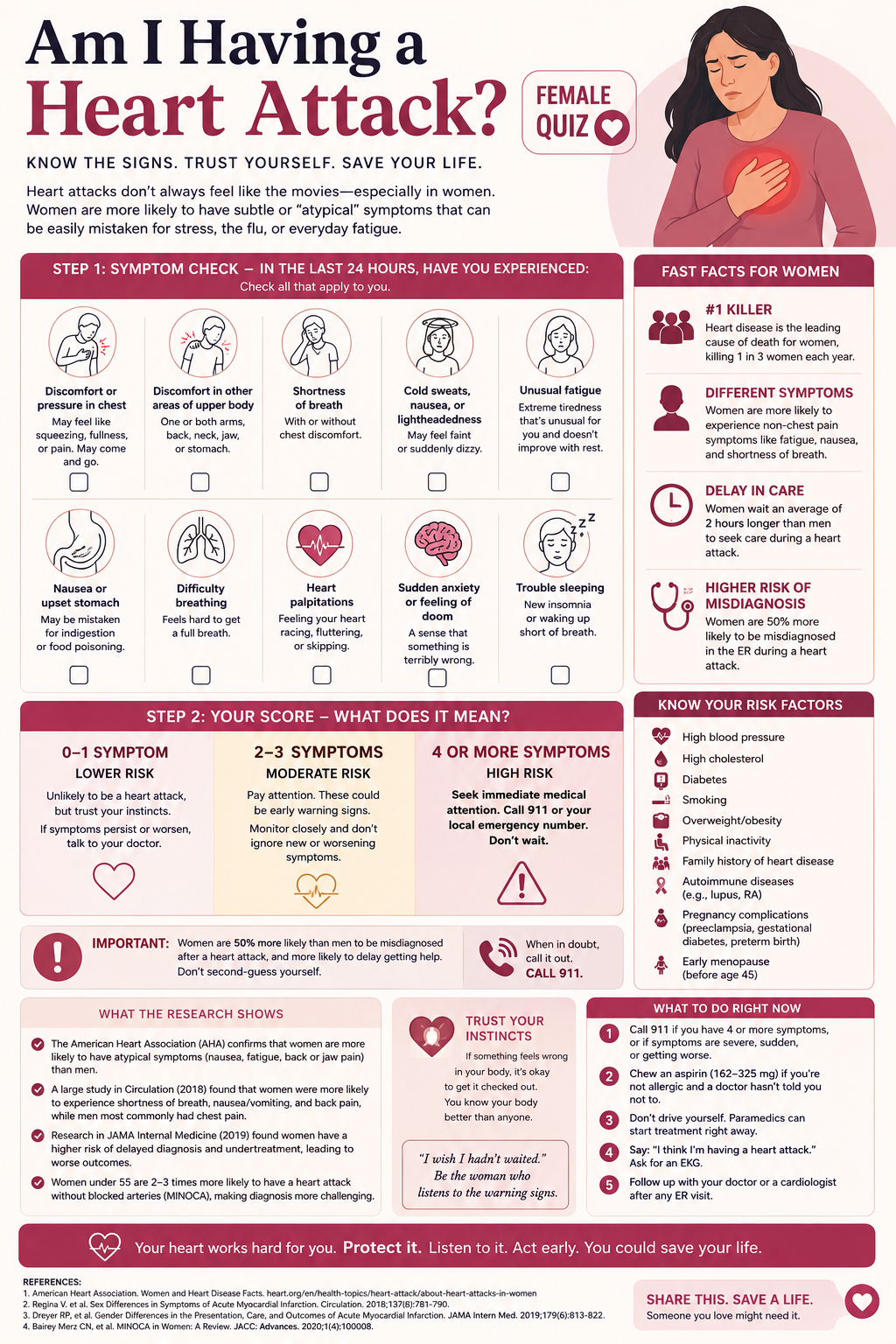
Now, the reason a heart attack quiz for women is important is because women often have different symptoms than men. Their signs can be quieter, less obvious, and sometimes even ignored. Heart disease is the number one cause of death for women in the U.S., and it kills over 250,000 women every year. Many women think their symptoms are just the flu, heartburn, stress, or just getting older. Knowing what to look for can save your life.
Why Are Women Different?
The idea that women rarely have chest pain during a heart attack is a myth. Chest pain or discomfort is still a common sign of a heart attack in women, just like in men. But women are more likely to have other symptoms that don’t match the usual picture and might not even have chest pain at all (Heart Attack Symptoms in Women – Healthline).
Women also tend to have heart attacks through different ways that standard tests may miss. They are more likely than men to have heart attacks without a major blockage in a big artery. The problem could be in the heart’s small vessels (microvascular disease), an artery spasm, or a tear in an artery wall (Spontaneous Coronary Artery Dissection – PubMed), which can happen in younger women and even during or after pregnancy. Symptoms may also appear when they’re resting or even while sleeping, and emotional stress can trigger them.
The Self-Check Quiz
Answer these questions. The more “yes” answers you have, especially if several come up at once or if the symptoms are new, strange, or getting worse, the more important it is to get help.
Symptoms happening right now
- Do you feel pressure, squeezing, tightness, or pain in your chest, especially the middle or left side?
- Does it last longer than a few minutes or go away and come back?
- Do you feel pain or discomfort in one or both arms, your back, neck, jaw, upper stomach, or even your throat, teeth, or ear? (In women, pain in the back, jaw, or right side is not uncommon).
- Are you having trouble breathing, with or without chest discomfort?
- Are you feeling sick to your stomach, throwing up, or having heartburn that won’t go away?
- Are you sweating heavily?
- Do you feel dizzy, lightheaded, or like you might faint?
- Are you suddenly very tired or weak, even for things you usually handle easily?
- Is your heart racing or fluttering (palpitations)?
A good way to think about it: Women often feel something is wrong without it being a dramatic pain. If something feels off, trust your body.
Your risk factors
- Are you over 55 or have gone through menopause? (Low estrogen after menopause raises heart disease risk, and menopause before 40 raises it even more — Menopause and Heart Disease – WebMD).
- Do you have high blood pressure, high LDL (“bad”) cholesterol, or diabetes? These risk factors are more important in women than in men.
- Do you smoke, have extra weight, or not get enough exercise?
- Did you have health problems during pregnancy, like high blood pressure, preeclampsia, gestational diabetes, preterm birth, or a pregnancy loss? (These are now known as long-term red flags for heart disease — Pregnancy Complications and Heart Risk – CDC.gov).
- Do you have polycystic ovary syndrome (PCOS), endometriosis, or got your first period early?
- Do you have an autoimmune or inflammatory condition like lupus or rheumatoid arthritis? Women are twice as likely as men to have these, and they increase heart disease risk.
- Did a parent or sibling get heart disease early — a mother or sister before 65, or a father or brother before 55? Family history is especially important for women.
What Do Your Answers Mean?
- If you have any active symptoms from questions 1–9: Especially chest discomfort, trouble breathing, or several symptoms together—call 911 right away. Don’t drive yourself if you can help it, and don’t try to wait it out. Many heart attacks start slowly with mild discomfort, which is why people often ignore them. Cardiologists say, “Time is muscle” — every minute you wait, your heart suffers more damage.
- If you don’t have active symptoms but said “yes” to several of the risk factor questions (10–16): It’s not an emergency, but it’s a good reason to see a doctor. Bring this list with you. Mention any pregnancy issues especially, since they change how you should be checked and might not come up otherwise.
Why Women Wait — and Why You Shouldn’t
Studies show women often wait longer to get help than men. Some put family or work first and downplay their own feelings. Others think a heart attack would be something obvious and dramatic. This is made worse because women are less likely to get certain tests, treatments, or rehab referrals.
That’s why it’s important to speak up for yourself. If something doesn’t feel right and you’re not being taken seriously, say, “I’m worried this is my heart.” Ask if your symptoms could be related to the heart. Find a doctor who listens.
The Bottom Line
This quiz can help you learn more, but it can’t replace medical care. A low score doesn’t mean you should ignore symptoms that frighten you. Heart attacks in women can be hard to recognize and are dangerous to ignore. Trust your instincts more than any checklist. When you’re unsure, call 911 — survivors almost never regret going to the ER.
Medical Disclaimer
The information and self-check tools provided in this article are intended strictly for educational and awareness purposes. This content cannot diagnose a medical condition and must never be used as a substitute for professional medical advice, evaluation, diagnosis, or emergency treatment.